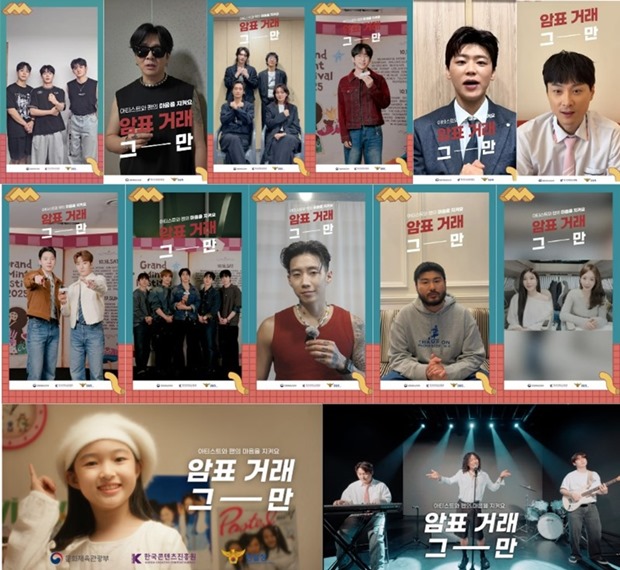
The campaign was carried out with unity from artists and fans.
The government has approved the anti-ticket scalping law in the National Assembly.
The Korea Music Industry Association (KMIA) has successfully completed its project on monitoring ticket scalping and anti-scalping campaigns, in collaboration with the Ministry of Culture, Sports, and Tourism and the Korea Creative Contents Agency. This initiative, running from May to December 2025, aimed to promote fair ticket distribution and raise awareness about ticket scalping in the industry.
The anti-scalping campaign saw enthusiastic participation from various artists. The band O'flowers created a campaign song titled 'Another Way', serving as a focal point for a relay video featuring 11 artists sharing the anti-scalping message. This video is available on the YouTube channel of the Korea Creative Contents Agency. In addition, the campaign was actively conducted at venues like the 'BLACKPINK World Tour in Goyang' and '2025 Let’s Rock Festival', providing opportunities for face-to-face interaction with audiences.
KMIA established the country's first dedicated ticket scalping monitoring system, 'SMAIT', analyzing suspected transactions on major secondhand platforms. They also engaged the audience actively through various programs allowing them to report scalping incidents, thereby enhancing the connection with fans.
Recently, ticket scalping has emerged as a significant issue within the Korean music industry, highlighting the growing societal demand for fair ticket distribution. Fans desire an environment where they can trust that artists are not exploited, and campaigns like this one provide an opportunity for both artists and fans to unite in addressing these social challenges.
The establishment of the 'SMAIT' system by KMIA is anticipated to play a crucial role in gathering essential data for future policy reforms. The insights gained from this system will clarify the reality of ticket scalping and significantly aid in strengthening legal and policy responses moving forward. With the government's passage of critical legislation, this approach is likely to yield more systematic results.
The involvement of artists in the KMIA campaign is particularly significant. Their influence delivers positive messages to fans, contributing to a shift in perception regarding concert culture. Such participation can be an essential factor in enhancing the sustainability of the concert industry.
This article is KOSTAR’s reinterpretation of a story originally reported by TVDaily.
Photo: KMIA